ACCREDITATION
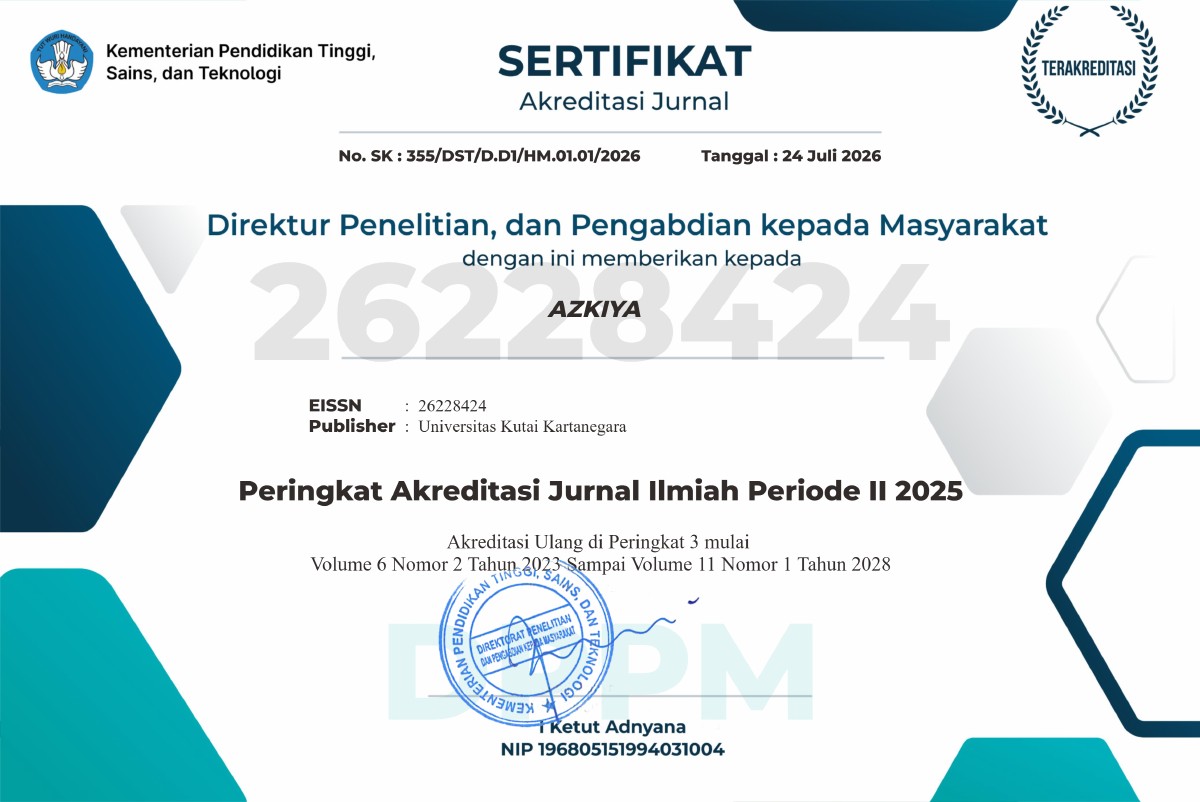
SINTA 3 ACCREDITED
Decree No. 355/DST/D.D1/HM.01.01/2026
24 July 2026
24 July 2026
Accreditation Period
Vol. 6 No. 2 (2023) – Vol. 11 No. 1 (2028)
Vol. 6 No. 2 (2023) – Vol. 11 No. 1 (2028)

AZKIYA: Jurnal Ilmiah Pengkajian dan Penelitian Pendidikan Islam relies on qualified reviewers to ensure the academic quality, originality, methodological rigor, ethical compliance, and scholarly contribution of manuscripts considered for publication.
AZKIYA applies a double-anonymous peer-review process, meaning that reviewers do not know the identity of the authors and authors do not know the identity of the reviewers.
Reviewers are expected to:
Reviewers should evaluate manuscripts based on the following criteria:
Relevance and Scope
The manuscript should be clearly relevant to the focus and scope of AZKIYA.
Originality and Novelty
The study should demonstrate originality and make a clear scholarly contribution.
Research Problem and Objectives
The research problem, objectives, or research questions should be clearly formulated.
Literature Review and Theoretical Foundation
The manuscript should engage with relevant and current scholarly literature and present an appropriate theoretical foundation.
Research Method
The method should be appropriate, transparent, systematic, and sufficiently explained.
Results
The findings should be clearly presented and supported by adequate evidence.
Discussion
The discussion should interpret the findings critically, relate them to previous research and theory, and explain their academic significance.
Conclusion
The conclusion should directly address the research objectives and accurately reflect the findings.
References
References should be relevant, credible, sufficiently current, and consistently presented.
Academic Writing
The manuscript should be logically structured, coherent, and written in appropriate academic language.
After completing the review, reviewers may recommend one of the following:
Reviewer recommendations are advisory. The final decision regarding publication remains the responsibility of the Editor.
All manuscripts received for review must be treated as confidential documents.
Reviewers must not:
The confidentiality obligation remains in effect even after the review process has been completed.
Reviewers should decline a review invitation when an actual or potential conflict of interest may affect their impartiality.
Potential conflicts include:
When uncertain, reviewers should disclose the potential conflict to the Editor.
If reviewers identify suspected:
they should immediately inform the Editor and provide sufficient information to support the concern.
Reviewers should not directly investigate or contact the authors regarding suspected misconduct.
Reviewer comments should be professional, specific, respectful, and academically useful.
Personal criticism, insulting language, discriminatory remarks, or comments unrelated to the academic quality of the manuscript are unacceptable.
Reviewers are encouraged to distinguish clearly between:
Major Comments — issues affecting the validity, originality, methodology, interpretation, or contribution of the manuscript.
Minor Comments — issues involving clarity, language, presentation, formatting, references, or minor corrections.
Reviewers should accept a review assignment only if they can reasonably complete it within the requested timeframe.
If additional time is needed, the reviewer should promptly communicate with the Editorial Team.
If the reviewer is unable to complete the review, the invitation should be declined as early as possible so that another reviewer can be assigned.
Reviewers must protect the confidentiality of submitted manuscripts.
Unpublished manuscripts, reviewer reports, author information, or confidential editorial materials should not be uploaded to external Generative AI systems where confidentiality and data protection cannot be guaranteed.
Reviewers remain fully responsible for the content, accuracy, integrity, and confidentiality of their review reports.
AZKIYA recognizes the essential contribution of reviewers to scholarly publishing.
Reviewer participation may be acknowledged through reviewer lists, certificates, letters of appreciation, or other forms of recognition, while maintaining the confidentiality required by the journal's double-anonymous review policy.
Reviewers should provide their assessment independently.
Recommendations should not be influenced by:
The review should be based solely on the scholarly quality and integrity of the manuscript.
By accepting a review invitation from AZKIYA, reviewers agree to uphold the principles of:
confidentiality, objectivity, integrity, fairness, academic responsibility, and constructive scholarly communication.