ACCREDITATION
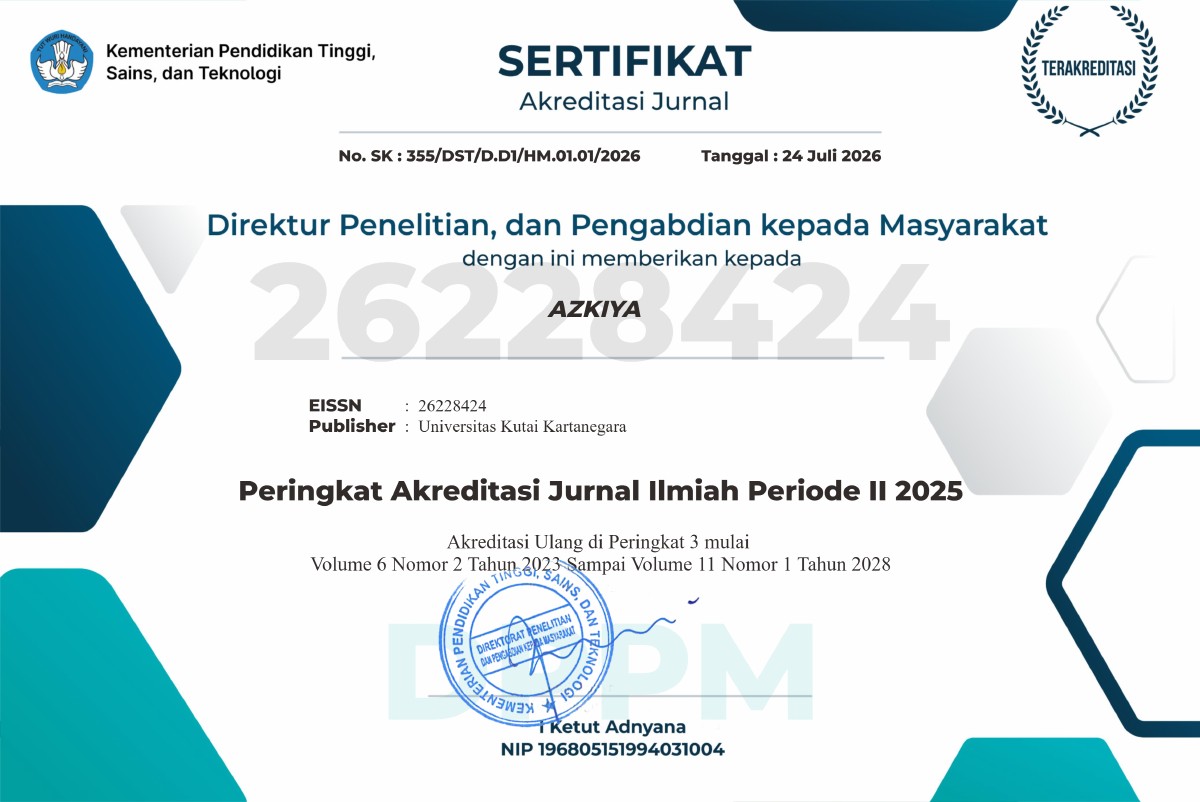
SINTA 3 ACCREDITED
Decree No. 355/DST/D.D1/HM.01.01/2026
24 July 2026
24 July 2026
Accreditation Period
Vol. 6 No. 2 (2023) – Vol. 11 No. 1 (2028)
Vol. 6 No. 2 (2023) – Vol. 11 No. 1 (2028)
AZKIYA: Jurnal Ilmiah Pengkajian dan Penelitian Pendidikan Islam is committed to ensuring the long-term preservation, accessibility, and integrity of all published scholarly content.
The journal maintains its digital content through the Open Journal Systems (OJS) platform and applies regular data-management and backup procedures to protect published articles, metadata, editorial records, and other journal materials.
All published articles and related metadata are stored and maintained within the journal's OJS platform.
The Editorial Team is responsible for ensuring that journal content remains accessible and that published materials are preserved in a stable digital environment.
The journal implements regular backup procedures for important journal data, including:
Backups are maintained to minimize the risk of data loss due to technical failure, system disruption, or other unforeseen circumstances.
Once an article has been formally published, AZKIYA is committed to maintaining the article as part of the permanent scholarly record.
Published articles will remain accessible through the journal website unless changes are required under the journal's policies concerning:
Any correction or retraction will be handled transparently and linked to the original publication whenever applicable.
AZKIYA maintains article metadata to support long-term discoverability and scholarly access.
Article metadata may be distributed or harvested by scholarly indexing, repository, citation, and discovery services used by the journal.
This helps ensure that the bibliographic record of published articles remains discoverable beyond the journal website.
The journal encourages the preservation and dissemination of published scholarly works through appropriate institutional and academic repositories, subject to the journal's copyright and licensing policies.
Authors may archive permitted versions of their articles in institutional repositories, personal academic profiles, or other scholarly platforms in accordance with the journal's open-access policy.
AZKIYA supports open access to published scholarly content.
The journal seeks to maintain continuous online access to articles so that researchers, educators, students, and the wider academic community can access and use published works for legitimate scholarly purposes.
The journal periodically maintains and updates its OJS platform to support system security, data integrity, compatibility, and continued accessibility.
Technical maintenance is carried out in coordination with the journal's institutional and website management support.
AZKIYA recognizes digital preservation as an essential part of responsible scholarly publishing.
The journal is committed to taking reasonable technical and administrative measures to ensure that published content and metadata remain accessible, authentic, and usable over the long term.