ACCREDITATION
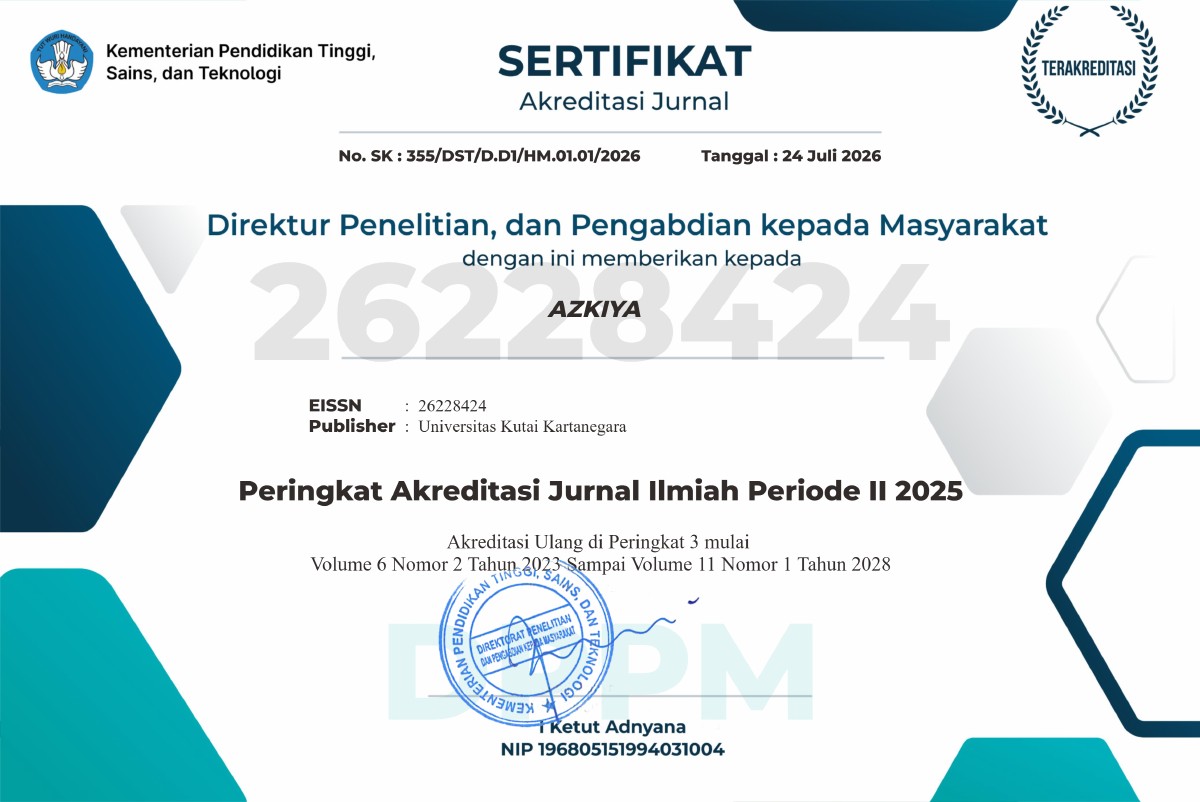
SINTA 3 ACCREDITED
Decree No. 355/DST/D.D1/HM.01.01/2026
24 July 2026
24 July 2026
Accreditation Period
Vol. 6 No. 2 (2023) – Vol. 11 No. 1 (2028)
Vol. 6 No. 2 (2023) – Vol. 11 No. 1 (2028)

AZKIYA: Jurnal Ilmiah Pengkajian dan Penelitian Pendidikan Islam applies a double-anonymous peer-review process, in which the identities of authors and reviewers are concealed from each other throughout the review process.
The peer-review process is intended to ensure the academic quality, originality, relevance, methodological rigor, and contribution of every manuscript considered for publication.
All submitted manuscripts are first evaluated by the Editorial Team.
The initial screening includes:
Manuscripts that do not meet the journal's minimum requirements may be declined at this stage without external review.
Manuscripts that pass the initial screening are assigned to reviewers with expertise relevant to the subject of the manuscript.
As a general principle, each manuscript is reviewed by at least two independent reviewers.
The Editorial Team considers reviewer expertise, academic competence, availability, and potential conflicts of interest when selecting reviewers.
Authors may suggest potential reviewers, but the final selection of reviewers remains entirely at the discretion of the Editor.
AZKIYA applies a double-anonymous review model.
This means:
Authors are therefore required to remove identifying information from the manuscript file where necessary before submission.
Reviewers are required to maintain the confidentiality of the manuscript and must not disclose, distribute, reproduce, or use unpublished material for personal benefit.
Reviewers evaluate manuscripts based on several academic criteria, including:
After evaluating the manuscript, reviewers may recommend one of the following decisions:
Reviewer recommendations are advisory. The final editorial decision is made by the Editor based on the reviewers' comments, the academic quality of the manuscript, and the journal's editorial policies.
When revisions are required, authors must respond carefully to all reviewer and editor comments.
Authors should:
The revised manuscript may be returned to the original reviewers for further evaluation when necessary.
The Editor makes the final decision regarding publication.
The decision may consider:
The final decision may be:
Accept Submission — Revisions Required — Resubmit for Review — Decline Submission.
AZKIYA seeks to conduct the peer-review process efficiently while maintaining academic quality.
The duration of the review process may vary depending on reviewer availability, manuscript complexity, and the number of revision rounds required.
Authors will be informed of editorial decisions and revision requests through the OJS system and registered email address.
Reviewers must disclose any actual or potential conflict of interest before accepting a review assignment.
Reviewers should decline the invitation if they have:
All manuscripts under review are treated as confidential documents.
Editors and reviewers must not share information about submitted manuscripts with unauthorized parties.
Unpublished data, arguments, interpretations, or ideas obtained through peer review must not be used for personal research or other purposes without the explicit permission of the authors.
If reviewers identify suspected plagiarism, duplicate publication, data manipulation, unethical research practices, inappropriate authorship, citation manipulation, or other forms of misconduct, they should immediately inform the Editor.
The Editorial Team will evaluate the concern and take appropriate action in accordance with the journal's Publication Ethics and Malpractice Statement.
Peer-review and editorial decisions are based solely on scholarly merit, methodological quality, relevance, originality, and ethical compliance.
Decisions must not be influenced by the author's gender, ethnicity, religion, nationality, institutional affiliation, political views, or other irrelevant considerations.