ACCREDITATION
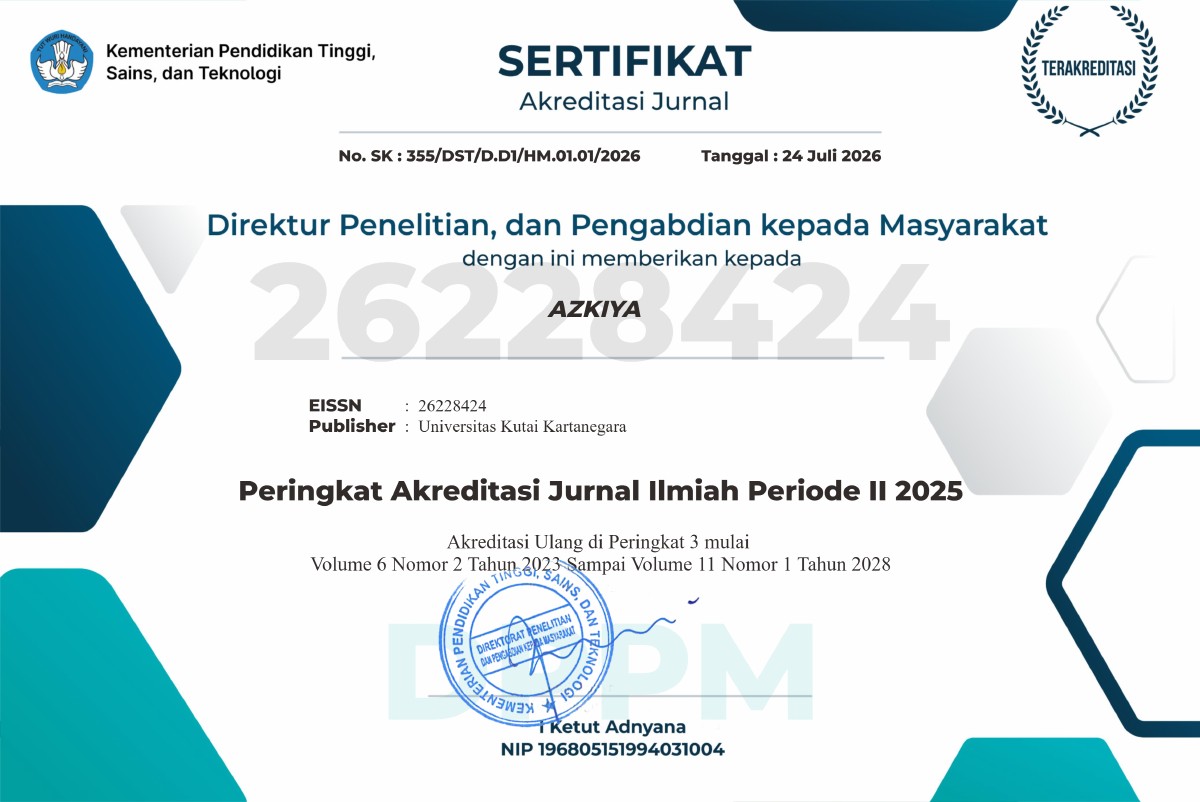
SINTA 3 ACCREDITED
Decree No. 355/DST/D.D1/HM.01.01/2026
24 July 2026
24 July 2026
Accreditation Period
Vol. 6 No. 2 (2023) – Vol. 11 No. 1 (2028)
Vol. 6 No. 2 (2023) – Vol. 11 No. 1 (2028)
AZKIYA: Jurnal Ilmiah Pengkajian dan Penelitian Pendidikan Islam is committed to maintaining academic integrity and preventing plagiarism in all manuscripts submitted for publication.
All manuscripts submitted to AZKIYA may undergo similarity screening before entering or during the editorial and peer-review process. The screening is intended to identify possible plagiarism, inappropriate citation, duplicate publication, excessive textual overlap, and other forms of unethical scholarly practice.
As a general administrative requirement, manuscripts submitted to AZKIYA should have an overall similarity index of 20% or lower.
Plagiarism includes, but is not limited to:
Authors must appropriately cite their own previously published work when it is reused.
Limited text recycling may be acceptable in certain methodological or technical descriptions when unavoidable and properly contextualized. However, substantial reuse of previously published content without disclosure may be considered self-plagiarism or redundant publication.
Authors must not submit a manuscript that substantially duplicates their own previously published work.
AZKIYA does not determine plagiarism solely on the basis of a numerical similarity percentage.
A manuscript with a relatively low similarity score may still contain plagiarism if important passages are copied without attribution. Conversely, a manuscript with a higher similarity score may contain legitimate similarities arising from references, commonly used terminology, methodological descriptions, or properly quoted material.
Therefore, similarity reports are evaluated by the Editorial Team based on academic judgment and the context of the detected overlap.
If problematic similarity or suspected plagiarism is detected, the Editorial Team may take one or more of the following actions:
The action taken will depend on the nature, extent, and seriousness of the violation.
If plagiarism is identified before publication, the manuscript may be returned to the author for revision or rejected.
Serious cases involving substantial copying, duplicate publication, fabricated material, or deliberate misrepresentation may result in immediate rejection.
Repeated violations may also affect the author's eligibility for future submissions to AZKIYA.
If credible evidence of plagiarism is discovered after an article has been published, the Editorial Team will investigate the matter.
Depending on the seriousness of the case, the journal may issue:
Correction, when the problem can be resolved without invalidating the article;
Expression of Concern, when serious concerns exist but the investigation is incomplete; or
Retraction, when plagiarism, duplication, fabrication, or other misconduct substantially compromises the integrity of the published article.
Authors are fully responsible for ensuring that:
Authors are strongly encouraged to conduct their own similarity check before submission.
The use of Generative Artificial Intelligence does not exempt authors from plagiarism and originality requirements.
Authors remain fully responsible for ensuring that AI-assisted content does not:
Substantive use of AI should be disclosed when relevant in accordance with AZKIYA's publication ethics policy.
AZKIYA expects all authors to uphold principles of honesty, originality, transparency, accountability, and responsible scholarly communication.
Manuscripts that fail to comply with these principles may be rejected or subject to further editorial action.