ACCREDITATION
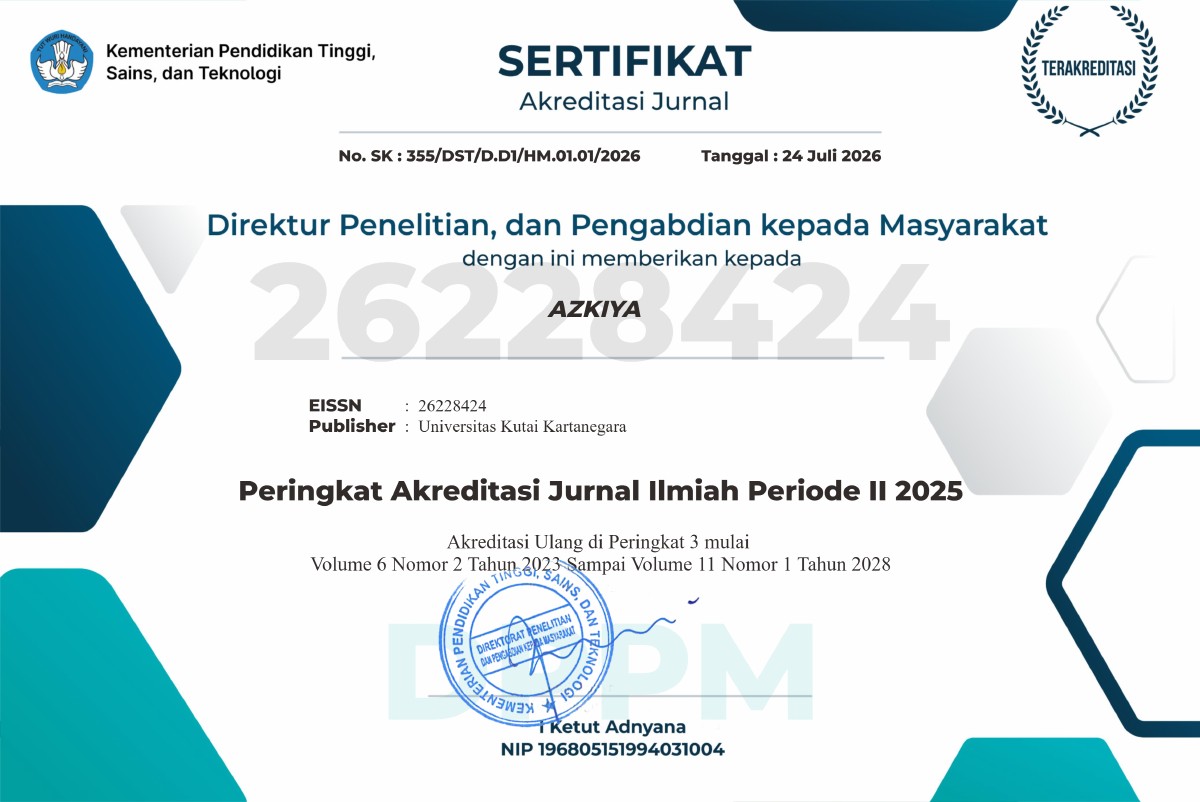
SINTA 3 ACCREDITED
Decree No. 355/DST/D.D1/HM.01.01/2026
24 July 2026
24 July 2026
Accreditation Period
Vol. 6 No. 2 (2023) – Vol. 11 No. 1 (2028)
Vol. 6 No. 2 (2023) – Vol. 11 No. 1 (2028)

AZKIYA: Jurnal Ilmiah Pengkajian dan Penelitian Pendidikan Islam is a peer-reviewed scholarly journal committed to maintaining integrity, transparency, fairness, and accountability in academic publishing.
This publication ethics statement applies to authors, editors, reviewers, editorial board members, and the publisher. AZKIYA is committed to following the ethical principles and core practices established by the Committee on Publication Ethics (COPE).
The journal does not tolerate plagiarism, fabrication, falsification, data manipulation, duplicate publication, authorship manipulation, citation manipulation, undisclosed conflicts of interest, peer-review manipulation, or other forms of research and publication misconduct.
Authors must present their research accurately, objectively, and honestly. Research methods, data, findings, and conclusions must be reported clearly and in sufficient detail.
Authors must not fabricate, falsify, omit, or manipulate research data. Where necessary, authors should be prepared to provide supporting data or research documents for editorial verification, subject to ethical, legal, and confidentiality considerations.
Authors must ensure that the submitted manuscript is original and has not been published previously.
The ideas, words, data, tables, figures, instruments, or other materials belonging to others must be appropriately cited or acknowledged. Plagiarism, inappropriate paraphrasing, self-plagiarism, and excessive duplication of previously published material are unacceptable.
All manuscripts may be examined using plagiarism-detection software. Editorial decisions will not be based solely on a similarity percentage but also on the nature and context of the detected similarities.
Authors must not submit the same manuscript simultaneously to more than one journal.
Manuscripts derived from theses, dissertations, conference papers, or previous research reports may be considered when the original source is disclosed, appropriately cited, and substantially developed into a journal article.
Authorship must be limited to individuals who have made significant academic contributions to the conception, design, implementation, analysis, or preparation of the manuscript.
All authors must:
Guest authorship, honorary authorship, purchased authorship, and ghost authorship are prohibited. Individuals who contributed but do not qualify as authors should be mentioned in the acknowledgements.
Any request to add, remove, or rearrange authors must be accompanied by a valid explanation and written consent from all authors.
Authors must properly acknowledge publications and other sources that influenced the research.
References must be relevant, accurate, and verifiable. Excessive self-citation, irrelevant citation, citation exchange, and other forms of citation manipulation are prohibited.
Authors must disclose any financial, institutional, personal, professional, or other interests that could influence the research or interpretation of the findings.
All sources of research funding and institutional support must be clearly stated. Authors must also declare when no conflict of interest exists.
Research involving human participants must comply with applicable ethical standards and institutional regulations.
Where required, authors must provide information concerning ethical approval, research permission, and informed consent. Research involving children or other vulnerable participants must obtain appropriate consent from parents, guardians, or authorized representatives, as well as participant assent where applicable.
The privacy, dignity, safety, anonymity, and confidentiality of participants must be protected. Identifiable photographs, quotations, recordings, or personal information must not be published without appropriate permission.
Artificial intelligence tools cannot be listed as authors because they cannot assume responsibility for the submitted work.
Authors remain fully responsible for the accuracy, originality, references, analysis, and integrity of all manuscript content. Substantive use of AI for writing, translation, data analysis, image generation, coding, or other research activities must be disclosed transparently.
Authors must ensure that AI-assisted content does not contain fabricated references, inaccurate information, plagiarism, copyright violations, or confidential research data.
When authors discover a significant error in a submitted or published article, they must promptly notify the editorial team and cooperate in correcting or retracting the article.
Editors are responsible for deciding whether manuscripts are accepted, revised, or rejected.
Decisions must be based on the manuscript’s relevance to the journal’s focus and scope, originality, academic contribution, methodological quality, ethical compliance, and reviewer recommendations.
Editorial decisions must not be influenced by the author’s institutional affiliation, nationality, gender, ethnicity, religion, political views, social background, or personal relationship with the editorial team.
Editors must conduct an initial assessment of submitted manuscripts before sending them for peer review. This assessment includes:
Editors must select reviewers with relevant expertise and manage the peer-review process according to the model described on the journal’s Peer Review Process page.
Editors and editorial staff must maintain the confidentiality of submitted manuscripts, reviewer reports, author information, and editorial correspondence.
Unpublished materials or ideas contained in a manuscript must not be used for personal research or benefit without written permission from the author.
Editors must disclose and avoid conflicts of interest. An editor must not handle a manuscript involving the editor’s own work, close collaborators, students, supervisors, family members, or other relationships that could affect editorial independence.
Manuscripts submitted by editors or editorial board members must be handled independently by another editor without a conflict of interest.
Editors must take reasonable action when plagiarism, data manipulation, duplicate publication, authorship disputes, citation manipulation, unethical research, or other misconduct is suspected.
The parties concerned must be given an opportunity to provide clarification. When necessary, editors may request supporting data, ethical approval, consent documents, or information from the authors’ institution.
Reviewers must treat manuscripts and related information as confidential. Manuscripts must not be shared, discussed, copied, or used for personal benefit.
Reviewers must not upload manuscripts or unpublished data to public AI platforms or external services that cannot guarantee confidentiality.
Reviews must be conducted objectively, respectfully, and constructively.
Reviewer comments should focus on the academic content and provide clear arguments to help editors make decisions and authors improve their manuscripts. Personal criticism, discriminatory statements, and insulting language are unacceptable.
Reviewers should inform the editor when they identify possible plagiarism, duplicate publication, data irregularities, missing ethical approval, inappropriate citations, or other ethical concerns.
Reviewers must not directly accuse or contact authors but should report their concerns confidentially to the editor.
Reviewers must disclose any financial, institutional, collaborative, personal, or competitive conflict of interest.
A reviewer who cannot provide an independent and impartial assessment must decline the review assignment.
Reviewers should only accept manuscripts that match their expertise and can be reviewed within the specified period.
Reviewers who require additional time or are unable to complete the review must promptly inform the editor.
Authors, reviewers, and readers may submit complaints or appeals through the journal’s official contact address.
An appeal against an editorial decision must provide clear academic or procedural reasons. Appeals based solely on disagreement with reviewer comments will not automatically result in reconsideration.
Complaints involving an editor will be handled by another editor, the editorial board, or the publisher who has no conflict of interest.
AZKIYA is committed to maintaining the accuracy and integrity of the scholarly record.
A correction may be issued when an error does not invalidate the main findings of an article.
An expression of concern may be issued when serious questions arise regarding an article, but an investigation has not been completed.
An article may be retracted when its findings are unreliable because of serious error, plagiarism, fabrication, falsification, unethical research, duplicate publication, authorship manipulation, or peer-review manipulation.
Retracted articles will normally remain accessible but will be clearly marked as retracted and linked to a notice explaining the reason for the retraction.
The publisher supports editorial independence and must not interfere with individual decisions concerning the acceptance or rejection of manuscripts.
The publisher is responsible for supporting ethical journal management, maintaining the journal’s electronic platform, preserving published content, and facilitating corrections, retractions, or investigations when publication ethics concerns arise.
By submitting, reviewing, editing, or publishing an article in AZKIYA: Jurnal Ilmiah Pengkajian dan Penelitian Pendidikan Islam, all parties agree to uphold honesty, transparency, fairness, confidentiality, accountability, and responsibility for the integrity of the scholarly record.