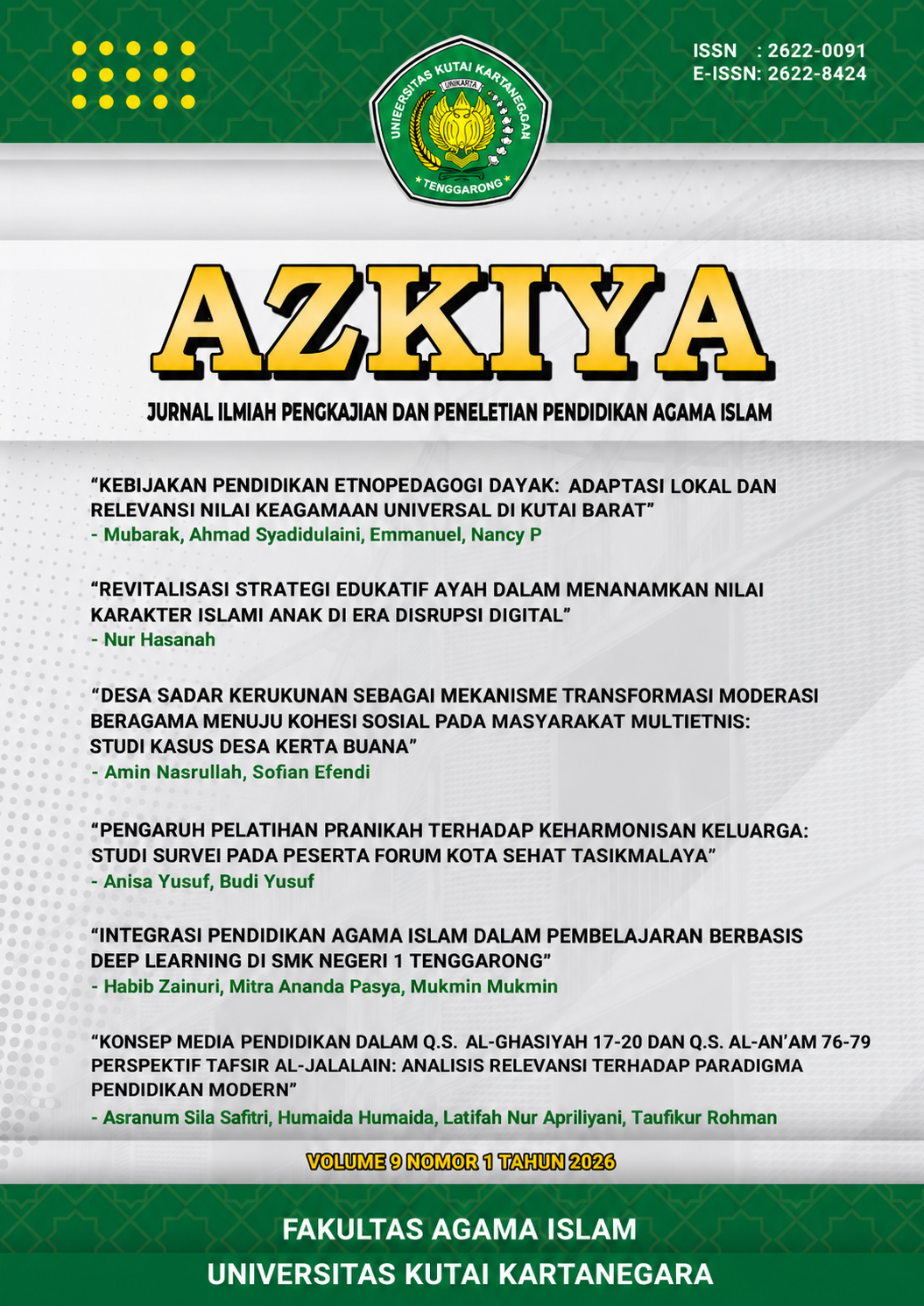
DESA SADAR KERUKUNAN SEBAGAI MEKANISME TRANSFORMASI MODERASI BERAGAMA MENUJU KOHESI SOSIAL PADA MASYARAKAT MULTIETNIS: STUDI KASUS DESA KERTA BUANA
DOI:
https://doi.org/10.53640/t6qaqd43Keywords:
Moderasi Beragama, Kohesi Sosial, Transformasi Sosial, Masyarakat Multietnis, MIDSK FrameworkAbstract
Penelitian ini menjelaskan mekanisme sosial yang mentransformasikan moderasi beragama menjadi kohesi sosial pada masyarakat multietnis dengan menjadikan Program Desa Sadar Kerukunan di Desa Kerta Buana, Kutai Kartanegara, sebagai explanatory case. Data diperoleh melalui wawancara mendalam, observasi, dan studi dokumentasi yang melibatkan unsur pemerintah, aparat desa, tokoh agama, tokoh masyarakat, dan warga yang dipilih secara purposif. Analisis mengikuti logika kualitatif interaktif berupa kondensasi data, penyajian data, verifikasi kesimpulan, kategorisasi tema, dan explanation building melalui dialog antara bukti empiris dan teori. Hasil penelitian mengidentifikasi mekanisme bertahap yang meliputi konstruksi makna bersama, internalisasi nilai, pembentukan kesadaran kolektif, penguatan modal sosial, dan kolaborasi kelembagaan. Berdasarkan sintesis tersebut, penelitian mengajukan Moderation Internalization through Desa Sadar Kerukunan (MIDSK) Framework sebagai kerangka eksplanatoris tingkat menengah berbasis kasus yang menghubungkan moderasi beragama sebagai normative input dengan kohesi sosial sebagai social outcome. Kerangka ini menegaskan bahwa kohesi tidak lahir secara langsung dari wacana normatif moderasi, tetapi melalui proses relasional dan kelembagaan yang mereproduksi nilai bersama. Karena bertumpu pada satu kasus strategis, kerangka ini ditujukan untuk generalisasi analitis, bukan statistik, dan memerlukan pengujian lintas kasus.
References
Abidin, A. A., & Fatawi, I. Leadership of Religious Leaders in the Framework of Religious Moderation in Strengthening Community Social Cohesion. International Journal of Multidisciplinary Research of Higher Education (IJMURHICA), 7(4), (2024): 266–277. https://doi.org/10.24036/ijmurhica.v7i4.238
Ansell, C., & Gash, A. “Collaborative governance in theory and practice,” Journal of Public Administration Research and Theory, 18(4) (1988): 543–571. https://doi.org/10.1093/jopart/mum032
Berger, P. L., & Luckmann, T. The Social Construction of Reality: A Treatise in the Sociology of Knowledge. Garden City, NY: Anchor Books, 1966.
Coleman, J. S. “Social capital in the creation of human capital,” American Journal of Sociology, 94, (1988): S95–S120. https://doi.org/10.1086/228943
Creswell, J. W., & Poth, C. N. Qualitative Inquiry and Research Design: Choosing Among Five Approaches (4th ed., Thousand Oaks, CA: Sage, 2018.
Denzin, N. K. The Research Act: A Theoretical Introduction to Sociological Methods (2nd ed.). New York: McGraw-Hill, 1978.
Durkheim, É. The Division of Labor in Society (W. D. Halls, Trans.), New York: Free Press, 1984. (Original work published 1893).
Emerson, K., Nabatchi, T., & Balogh, S. “An integrative framework for collaborative governance,” Journal of Public Administration Research and Theory, 22(1) (2012): 1–29. https://doi.org/10.1093/jopart/mur011
Kementerian Agama Republik Indonesia, Moderasi Beragama (Jakarta: Badan Litbang dan Diklat Kementerian Agama RI, 2019.
Kementerian Agama Republik Indonesia, Roadmap Penguatan Moderasi Beragama 2020–2024. Jakarta: Badan Litbang dan Diklat Kementerian Agama RI, 2022.
Liu, Y., Rakthin, C., & Budianto, L., “Religious Moderation and Community Cohesion: Exploring Social Memory, Identity, and Solidarity in the Phu Khao Thong Muslim Community, Ayutthaya,” Millah: Journal of Religious Studies, 24(1) (2025): 379–392. https://doi.org/10.20885/millah.vol24.iss1.art10
Maulana. M, Putri, N. N. A, Fahira, Z., “Unity in Diversity: Examining Religious Moderation across Religions in Indonesia,” Dialog, 47(1) (2024): 61-76. https://doi.org/10.47655/dialog.v47i1.910
Miles, M. B., Huberman, A. M., & Saldaña, J., Qualitative Data Analysis: A Methods Sourcebook (3rd ed.). Thousand Oaks, CA: Sage, 2014.
Patton, M. Q., Qualitative Research & Evaluation Methods (4th ed.). Thousand Oaks, CA: Sage, 2015.
Pratiwi, N. N., & Suniadewi, P. A., “Navigating Common Good for Religious Moderation in Indonesia’s Multicultural,” Pancasila: Jurnal Keindonesiaan, 4(1) (2024): 119–129. https://doi.org/10.52738/pjk.v4i1.437
Putnam, R. D., Making Democracy Work: Civic Traditions in Modern Italy. Princeton, NJ: Princeton University Press, 1993.
Putnam, R. D., Bowling Alone: The Collapse and Revival of American Community. New York: Simon & Schuster, 2000.
Putnam, R. D., "E Pluribus Unum: Diversity and Community in the Twenty-first Century," Scandinavian Political Studies 30, no. 2 (2007): 147-150.
Rasyidi, K.S., & Rozikin, Z., “Building an Inclusive Society through Religious Moderation Village: Phenomenological Study of the Role of Social Capital in Building Social Harmonization in the Community of Sidodadi Village,” International Journal of Research in Social Science and Humanities (IJRSS) ISSN:2582-6220, DOI: 10.47505 IJRSS, 6(6) (2025): 151-175. https://doi.org/10.47505/IJRSS.2025.6.10
Seniawati et al., “The Framework of Religious Moderation: A Socio-Theological Study on the Role of Religion and Culture from Indonesia's Perspective,” Social Sciences & Humanities, (2025). https://doi.org/10.1016/j.ssaho.2024.101271
Sholeh, M. I., & Fatinnah, S., “Strengthening Religious Moderation to Promote Social Cohesion and Peaceful Coexistence in Multicultural Societies,” MUNIF: International Journal of Religion Moderation, 1(1) (2025):1–19. https://doi.org/10.71305/munif.v1i1.442.
Stake, R. E., The Art of Case Study Research. Thousand Oaks, CA: Sage, 1995.
Tim Penyusun Kementerian Agama RI. (2019). Moderasi Beragama. Jakarta: Badan Litbang dan Diklat Kementerian Agama RI. ISBN 978-979-797-386-5. (Eperpus Kemenag).
Wardah, D., “Building Religious Moderation through Strengthening Mawaddah-Based Social Cohesion in Cigugur District, Kuningan Regency,” Jurnal Studi Sosial Keagamaan Syekh Nurjati, 4(2) (2024): 124-141. https://doi.org/10.24235/sejati.v4i2.86
Woolcock, M., “Social capital and economic development: Toward a theoretical synthesis and policy framework,” Theory and Society, 27(2) (1998): 151–208. https://doi.org/10.1023/A:1006884930135
Yazwardi, Y., Wijaya, S., & Erniwati, “Negotiating Religious Moderation and Legal Pluralism in Indonesia: A Socio-Anthropological Perspective,” Kuriositas, 18(1) (2025): 49-70. https://doi.org/10.35905/kur.v18i1.12106
Yin, R. K,. Case Study Research and Applications: Design and Methods (6th ed.). Thousand Oaks, CA: Sage, 2018.
Zuhri, M. K. et al., “Tolerance From Below: Grassroots Movement and Interfaith Collaboration for Religious Moderation in Indonesia,” Jurnal Penelitian, 21(1) (2024): 1-16. https://doi.org/10.28918/jupe.v21i1.2085
Downloads
Published
Issue
Section
License
Copyright (c) 2026 Amin Nasrullah, Sofian Efendi

This work is licensed under a Creative Commons Attribution 4.0 International License.