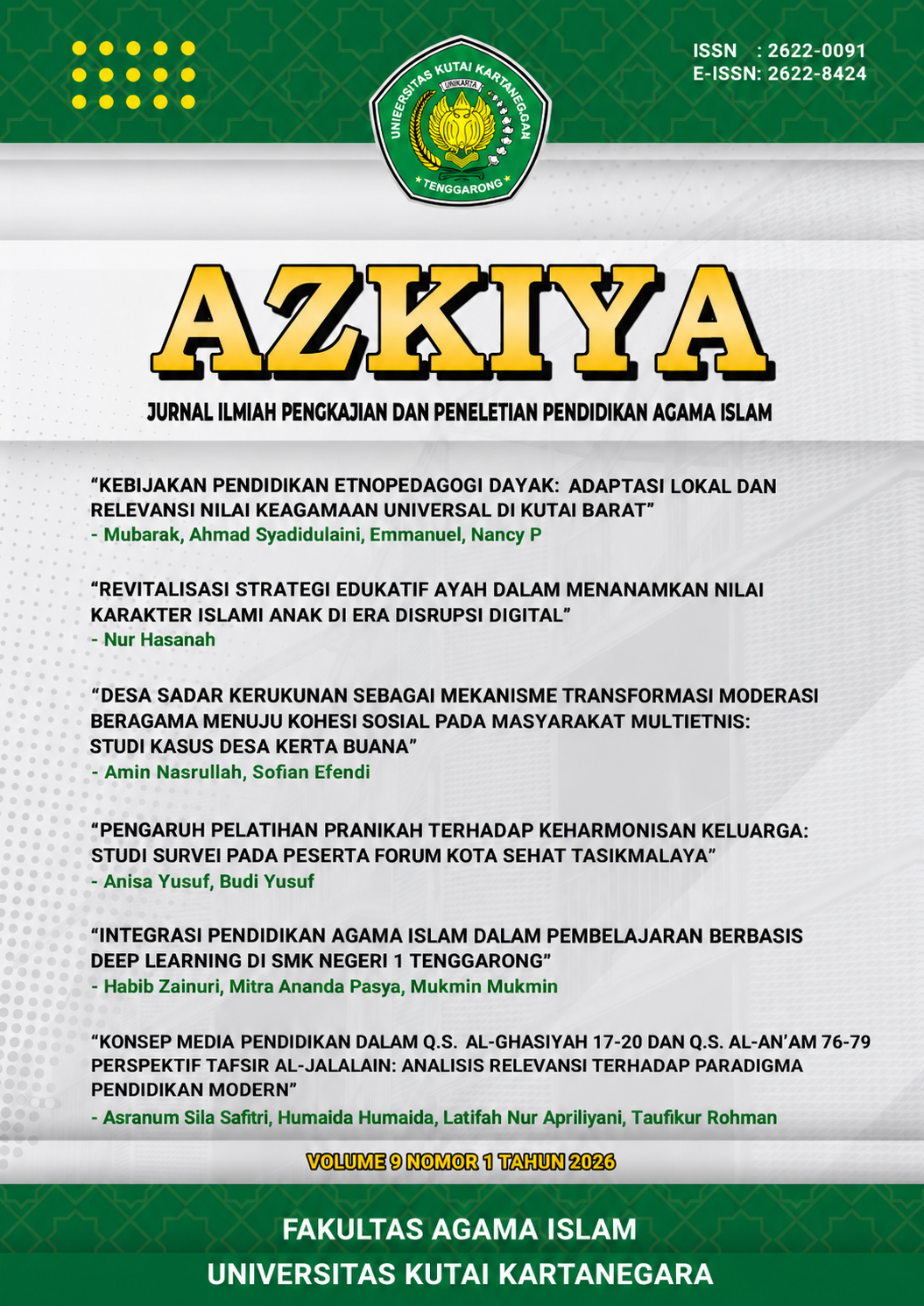
REVITALISASI STRATEGI EDUKATIF AYAH DALAM MENANAMKAN NILAI KARAKTER ISLAMI ANAK DI ERA DISRUPSI DIGITAL
DOI:
https://doi.org/10.53640/pr496793Keywords:
Keterlibatan Ayah, Pendidikan Karakter Islami, Digital Parenting, Literasi Digital, Disrupsi DigitalAbstract
This study aims to analyze the revitalization of fathers’ educational strategies in instilling Islamic character values in children in the era of digital disruption. This research employed a literature review method using qualitative content analysis of scholarly journals, academic books, research reports, and relevant sources concerning fathers’ roles, Islamic character education, and the impact of digital technology. The findings indicate that fathers play strategic roles as role models, educators, protectors, supervisors, and digital companions for their children. The revitalization of educational strategies includes modeling wise technology use, improving digital literacy, fostering open communication, providing proportionate supervision, establishing rules for gadget use, and allocating quality parenting time free from digital distractions. These strategies support children in developing honesty, responsibility, discipline, patience, and the ability to filter harmful content. Therefore, fathers’ emotional and educational involvement is essential in developing a generation with strong Islamic character, adaptability, and responsibility in digital spaces.
References
Bandura, A. (1977). Social learning theory. Prentice-Hall.
Cahyaningtyas, R. D., Wardani, A. E., & Ali, M. M. (2025). Islamic character education in the digital era: A case study of junior high schools. JISEI: Journal of Islamic Studies and Educational Innovation, 1(2), 172–186. https://doi.org/10.61094/jisei.v1i2.51
Evans, D. K., & Jakiela, P. (2025). The role of fathers in promoting early childhood development in low- and middle-income countries: A review of the evidence. The World Bank Research Observer, 40(2), 211–228. https://doi.org/10.1093/wbro/lkae009
Fam, J. Y., Juhari, R., Kääriäinen, M., & Männikkö, N. (2025). Reconsidering parental mediation with new media technology. Frontiers in Human Dynamics, 7, Article 1495954. https://doi.org/10.3389/fhumd.2025.1495954
Helsper, E. J., Veltri, G. A., & Livingstone, S. (2025). Parental mediation of children’s online risks: The role of parental risk perception, digital skills and risk experiences. New Media & Society, 27(11), 5986–6005. https://doi.org/10.1177/14614448241261945
Moleong, L. J. (2022). Metodologi penelitian kualitatif. Remaja Rosdakarya.
Puglisi, N., Rattaz, V., Favez, N., & Tissot, H. (2024). Father involvement and emotion regulation during early childhood: A systematic review. BMC Psychology, 12(1), Article 675. https://doi.org/10.1186/s40359-024-02182-x
Ramadhan, M. D. R., Anggraini, K. P., & Lintang, H. C. (2025). Kajian tafsir Q.S. An-Nisa ayat 34: Antara tanggung jawab dan otoritas dalam relasi gender. Taqrib: Journal of Islamic Studies and Education, 3(2), 229–238. https://doi.org/10.61994/taqrib.v3i2.1401
Rollè, L., Gullotta, G., Trombetta, T., Curti, L., Gerino, E., Brustia, P., & Caldarera, A. M. (2019). Father involvement and cognitive development in early and middle childhood: A systematic review. Frontiers in Psychology, 10, Article 2405. https://doi.org/10.3389/fpsyg.2019.02405
Sugiyono. (2022). Metode penelitian kuantitatif, kualitatif, dan R&D. Alfabeta.
Tan, C. Y., Pan, Q., Tao, S., Liang, Q., Lan, M., Feng, S., Cheung, H. S., & Liu, D. (2024). Conceptualization, measurement, predictors, outcomes, and interventions in digital parenting research: A comprehensive umbrella review. Educational Research Review, 45, Article 100647. https://doi.org/10.1016/j.edurev.2024.100647
Tan, C. Y., Xu, N., Liang, M., & Li, L. (2025). Meta-analysis of associations between digital parenting and children’s digital wellbeing. Educational Research Review, 48, Article 100699. https://doi.org/10.1016/j.edurev.2025.100699
Ulfa, M. (2026). The role of millennial fathers in early childhood Islamic education: A phenomenological study. Molang: Journal Islamic Education, 4(1), 22–33. https://doi.org/10.32806/jm.v4i1.1826
UNESCO. (2026). Growing up in a connected world: A family guide for the digital age. https://unesdoc.unesco.org/ark:/48223/pf0000398455
UNICEF Innocenti. (2025). Childhood in a digital world: Screen time, digital skills and mental health. https://www.unicef.org/innocenti/reports/childhood-digital-world
Zed, M. (2018). Metode penelitian kepustakaan. Yayasan Pustaka Obor Indonesia.
Zheng, Q., Cai, L., Huang, P., Huang, W., & Ni, Y. (2026). Father’s involvement is critical in social-emotional development in early childhood: A meta-analysis. Early Childhood Research Quarterly, 74, 26–34. https://doi.org/10.1016/j.ecresq.2025.08.001
Downloads
Published
Issue
Section
License
Copyright (c) 2026 Nur Hasanah

This work is licensed under a Creative Commons Attribution 4.0 International License.